
Industry pathways
Apply the same connected foundation to the way your business earns and delivers.
We keep the core workspace consistent, then emphasize the records, workflows, roles, and reports that matter most to each operating model.
Philippine business, different operating realities
A practical starting point for six common business models.
Keep client communication, working files, meetings, deliverables, time commitments, and billing context together
Use Mail, Connect, Suite, Calendar, Contacts, and Work Boards as the delivery spine, then connect Ledger beta when engagements need stronger receivables and management reporting.
Coordinate customers, suppliers, branches, stock context, schedules, and cash attention
Standardize daily communication and operating boards across locations, then evaluate Ledger beta for purchases, sales, inventory value, payables, receivables, and cash.
Give every location a common operating rhythm without removing local ownership
Use tenant domains, room membership, shared folders, templates, calendars, boards, services, and reports to compare and support branches.
Connect demand, materials, production, quality, inventory, costing, and delivery conversations
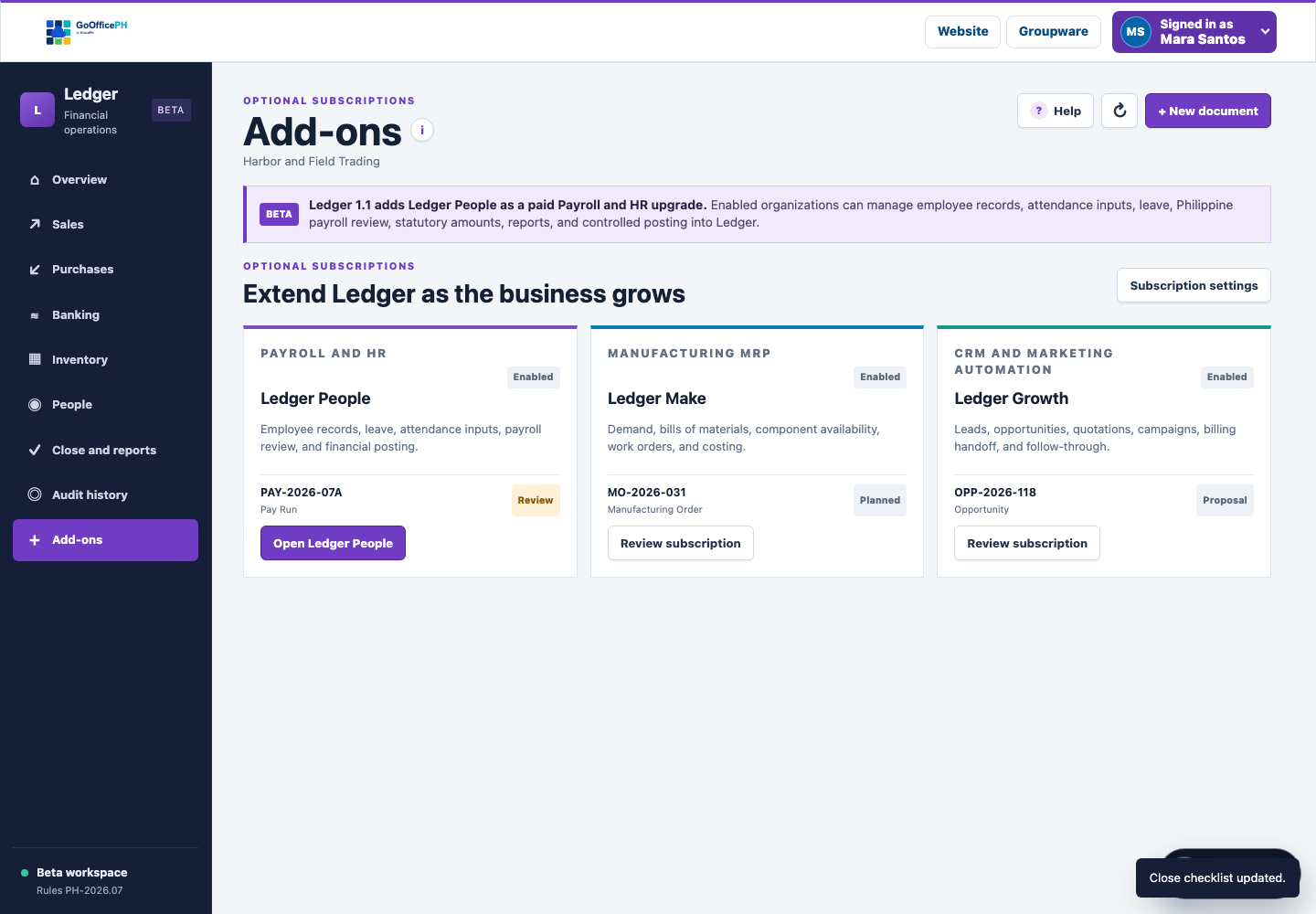
Use Groupware for coordination and Ledger Make when bills of materials, manufacturing orders, work in progress, traceability, and costing are enabled.
Keep requests, source documents, review, exceptions, client communication, and reporting accountable
Use tenant-aware workspaces and boards for client service, then evaluate Ledger beta as the controlled financial workspace where appropriate.
Connect fast-moving customer conversations to fulfillment and financial follow-through
Use Mail, Contacts, Connect, Calendar, Suite, and Work Boards now; add Ledger Growth when lead, campaign, quotation, billing, collection, and profit context needs one customer history.
Local context, globally recognizable discipline
Give a growing business the operating clarity larger organizations take for granted.
SMEs represent around 90 percent of businesses and more than half of employment worldwide, while Philippine MSMEs account for 99.63 percent of registered establishments in the DTI 2024 count. We translate enterprise patterns such as identity, connected records, workflow, audit, and reporting into a path smaller organizations can adopt progressively.
- Begin with the applications people already understand.
- Introduce structure at the point where risk or coordination requires it.
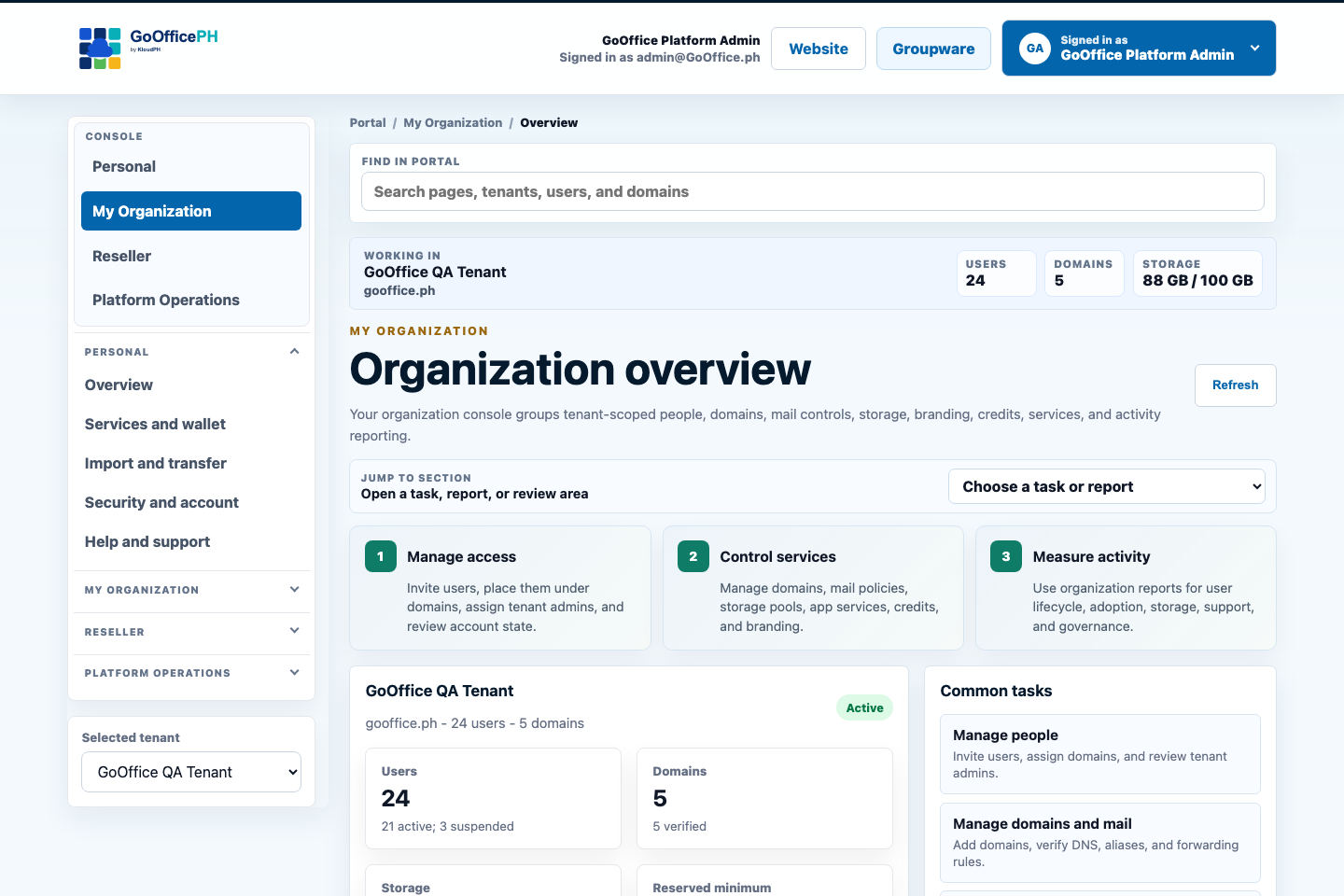
- Keep the organization, not the individual app, as the operating boundary.
- Use reports to improve adoption and control rather than merely document activity.
What changes by operating model
Use one foundation while emphasizing the right records and controls.
| Operating model | Critical connected records | Management focus |
|---|---|---|
| Project and professional service | Client messages, proposals, files, meetings, tasks, due dates, receivables | Delivery confidence, utilization, follow-up, and collection |
| Retail and distribution | Customers, suppliers, orders, stock, branches, schedules, payables, cash | Availability, margin, branch consistency, and cash conversion |
| Multi-branch service | People, domains, rooms, procedures, calendars, boards, support, reports | Standardization, local accountability, and exception visibility |
| Manufacturing | Demand, materials, work orders, output, quality, inventory, cost, delivery | Schedule adherence, material risk, traceability, and cost |
| Accounting and advisory | Client requests, source documents, review notes, filings, reports, communication | Completeness, reviewer accountability, deadlines, and evidence |
| Digital commerce | Leads, campaigns, messages, orders, fulfillment, billing, collections, support | Conversion, service speed, fulfillment, and customer value |
Industry adoption
Adapt the workflow without fragmenting the platform.
Does every industry receive a different version of GoOfficePH?
No. The identity, tenant, application, administration, security, audit, and reporting foundation stays consistent. Templates, enabled services, roles, workflows, and reports emphasize the needs of the operating model.
Can a business combine several industry patterns?
Yes. A company may operate stores, distribution, services, and light manufacturing at the same time. Tenant and domain structure, boards, folders, roles, and Ledger modules can reflect that combination.
Are Ledger industry modules already production-ready?
Ledger and its optional People, Make, and Growth modules are currently beta. They are presented as evaluation capabilities, not as production availability.
References
Explore the research and policy context behind this guidance.
Put the next step in reach
Choose the capability that will make the clearest difference to your team.
Start with one priority, keep the implementation manageable, and expand on the same connected foundation.