
Implementation built for adoption
Configure the platform, prove the workflow, and roll out at a pace people can absorb.
We combine technical readiness with role ownership, user experience, training, support, and measurable adoption so the new workspace becomes part of daily work.
Five implementation phases
Move from business outcome to sustained operating rhythm.
- 011. Discover
Define the business outcome, scope, owners, risks, and success measures
Agree on the first workflow, users, domains, source systems, policies, support model, and evidence that will count as success.
- 022. Configure
Prepare identity, tenant structure, services, storage, policy, and recovery
Build the destination around safe defaults, explicit roles, verified domains, clear administrators, and representative templates.
- 033. Prove
Run a realistic pilot across devices and roles
Use actual work patterns, migration samples, mobile and desktop browsers, guest flows, administrator actions, reporting, and support.
- 044. Roll out
Launch in manageable waves with visible help
Communicate the change, train by role, move data, monitor status, resolve exceptions, and keep ownership clear.
- 055. Improve
Use adoption, support, activity, security, and operating reports
Refine guidance, policy, templates, automations, services, and the next phase based on evidence from real use.
Implementation ownership
Give each decision and deliverable a named owner.
| Role | Primary responsibility | Key acceptance evidence |
|---|---|---|
| Executive sponsor | Business outcome, priority, decision escalation, and adoption expectation | Success measures, scope decisions, and launch authorization |
| Tenant owner | Organization structure, domains, administrators, services, storage, policy, and approvals | Configured tenant, verified domains, assigned roles, and accepted policy |
| Technical lead | Identity, DNS, source access, migration, routing, devices, security, and integration | Validated configuration, pilot results, exception log, and cutover checklist |
| Business process owner | Representative workflow, templates, approvals, reports, and operating rules | End-to-end scenario completed with expected roles and records |
| Change and training lead | Communication, role-based guidance, onboarding, office hours, and adoption | Training completion, user readiness, help usage, and feedback |
| Support owner | Triage, escalation, status communication, issue ownership, and closure | Support roster, severity model, response path, and resolved pilot issues |
First value before full configuration
Help each role finish one real task early.
Users remember a completed outcome more than a product tour. A strong onboarding path gets a user into the right account, through the first meaningful workflow, and to a visible result before secondary settings become the focus.
- Employee: receive mail, find a file, join a room, and complete a work item.
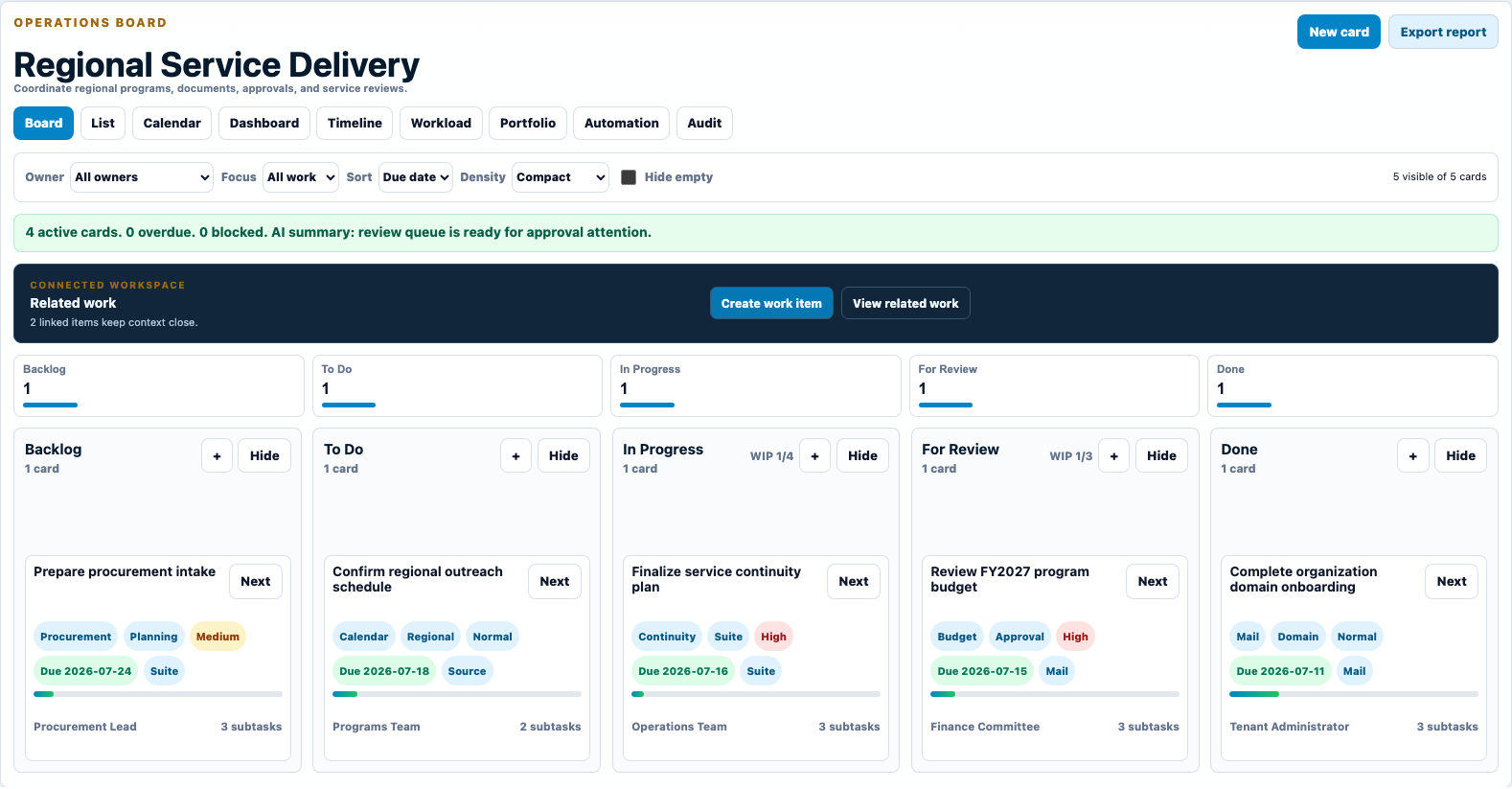
- Manager: review a board, approve a record, open a report, and resolve an exception.
- Tenant administrator: invite a user, place the user under the right domain, assign services, and confirm access.
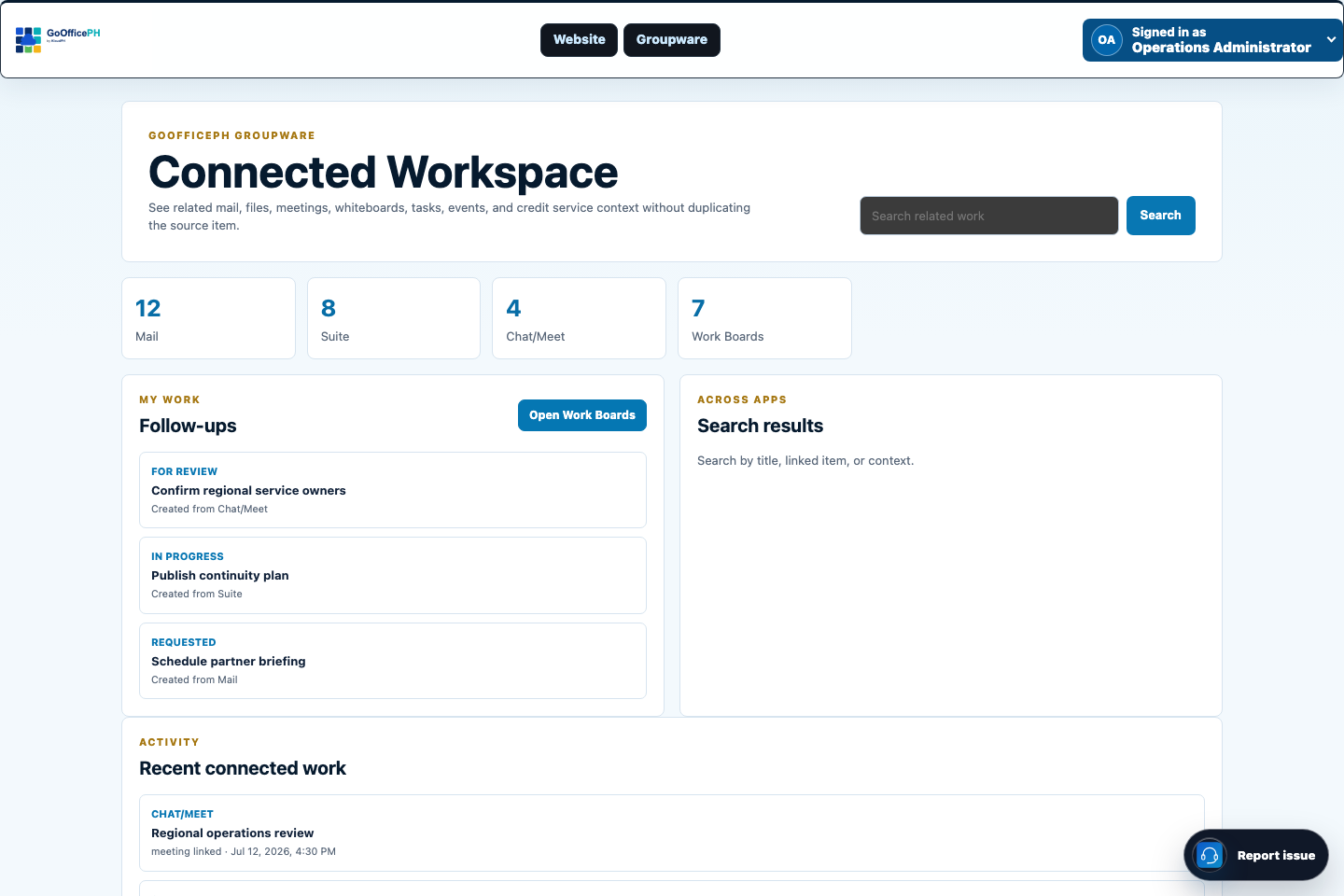
- Executive: open the operating summary and follow one signal to the work behind it.
Launch readiness
A complete launch is more than working sign-in.
Tenant, domains, users, groups, roles, services, storage, recovery contacts, and support ownership are confirmed.
Representative Mail, Connect, Suite, Calendar, Contacts, Work Boards, Whiteboard, Wallet, and Connected Workspace paths are tested as applicable.
User, tenant administrator, reseller, guest, and platform roles see the correct navigation and permissions.
Desktop, tablet, and mobile layouts are visually reviewed for navigation, scrolling, controls, dialogs, and readable content.
Migration counts, exceptions, routing, sign-in, sending, invitations, sharing, and recovery paths are reconciled.
Help, training, communications, issue reporting, escalation, status, and rollback decisions are ready.
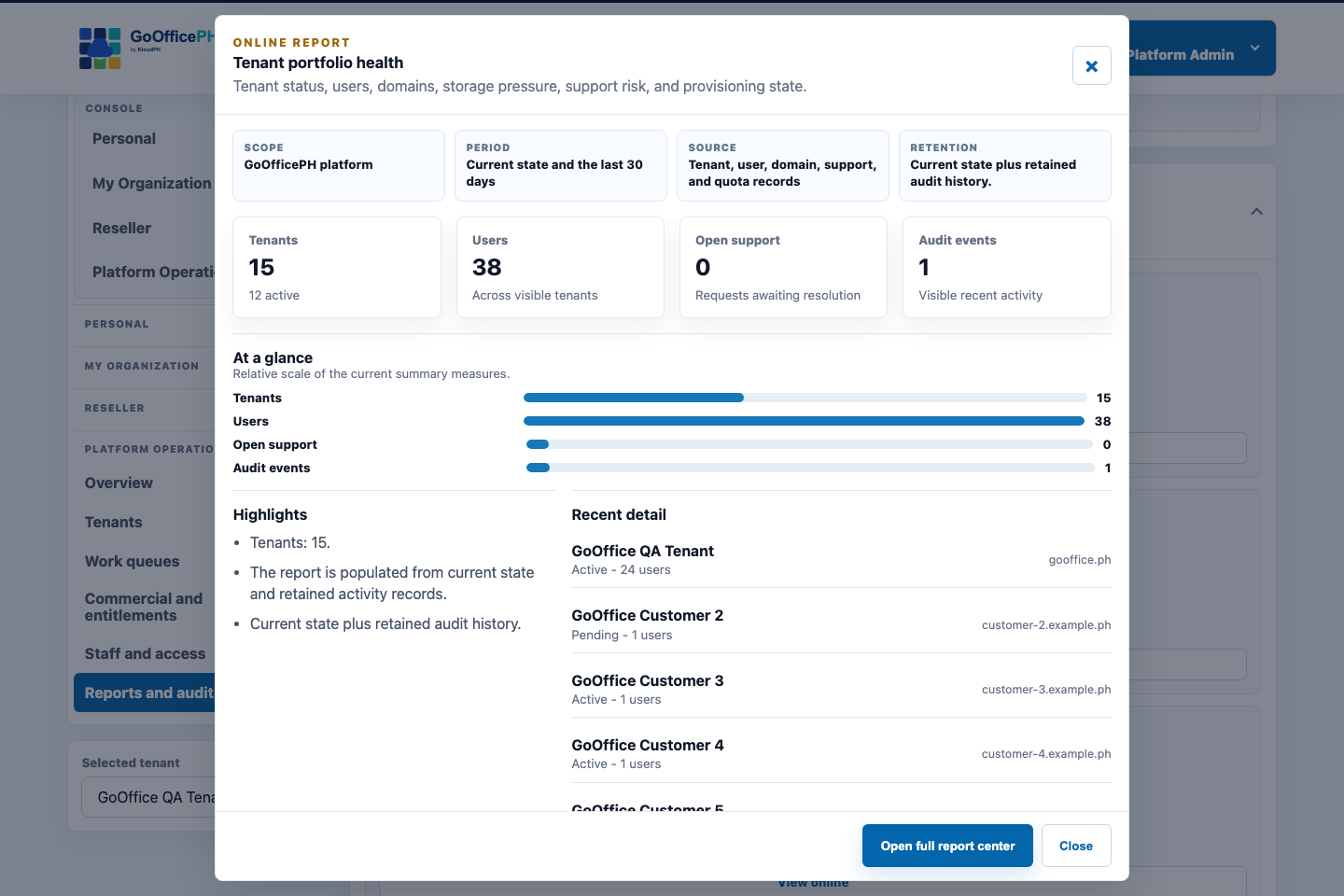
Adoption, support, activity, security, storage, service, and business reporting have named reviewers and review dates.
Improve from evidence
Use operating signals to decide what the business should adopt next.
The strongest implementation plan continues after launch. Role-scoped reports and support activity show where users are succeeding, where policy is unclear, and where another connected capability will remove friction.
- Adoption and active-use trends by app, tenant, domain, and role where authorized.
- Support volume, categories, response, resolution, and recurring issues.
- Storage, subscription, service, security, and mail-protection attention items.
- Audit detail behind material administrative and business actions.
Implementation questions
Make the rollout proportionate to the business.
How large should the pilot be?
Large enough to represent the important roles, devices, domains, data, workflows, and exceptions, but small enough that the team can observe and resolve issues quickly. The right number depends on organizational complexity, not a universal percentage.
Should every app launch on the same day?
Not necessarily. Start with the workflow that produces first value, then add connected capabilities in a sequence the team can learn and support. Dependencies such as identity, domains, mail routing, and shared files should be planned explicitly.
What should be measured after launch?
Measure successful access, active use, task completion, migration exceptions, support demand, security attention, storage, service health, and the business outcome chosen at discovery. Avoid treating login count alone as adoption.
When should beta applications enter an implementation plan?
Only as a separate evaluation track with explicit users, data boundaries, success criteria, and exit decisions. Beta should not silently become a production dependency.
References
Explore the research and policy context behind this guidance.
Put the next step in reach
Choose the capability that will make the clearest difference to your team.
Start with one priority, keep the implementation manageable, and expand on the same connected foundation.